Answer Engine Optimization: The Ultimate 2026 Guide to Getting Cited by AI:
Answer Engine Optimization (AEO) is the practice of structuring content so AI answer engines like ChatGPT, Perplexity, Google AI Overviews, Claude, and Gemini extract it and cite it as a direct answer to a question.
Where traditional SEO optimizes a page to rank in a list and earn a click, AEO optimizes a specific fact to be quoted inside the answer itself.
It is the discipline of becoming the source the machine repeats.
This is the complete guide. It covers what AEO is and where it came from, how it differs from SEO and GEO in concrete terms, how each major answer engine actually chooses its sources, the on-page and technical work that moves citation share.
How to measure something that hides inside answers you cannot see, and how a brand-new site with zero authority can win citations in weeks while its Google rankings slowly build underneath.
There is a lot here on purpose. AEO is not a single trick, and the pages that win treat it as a system.
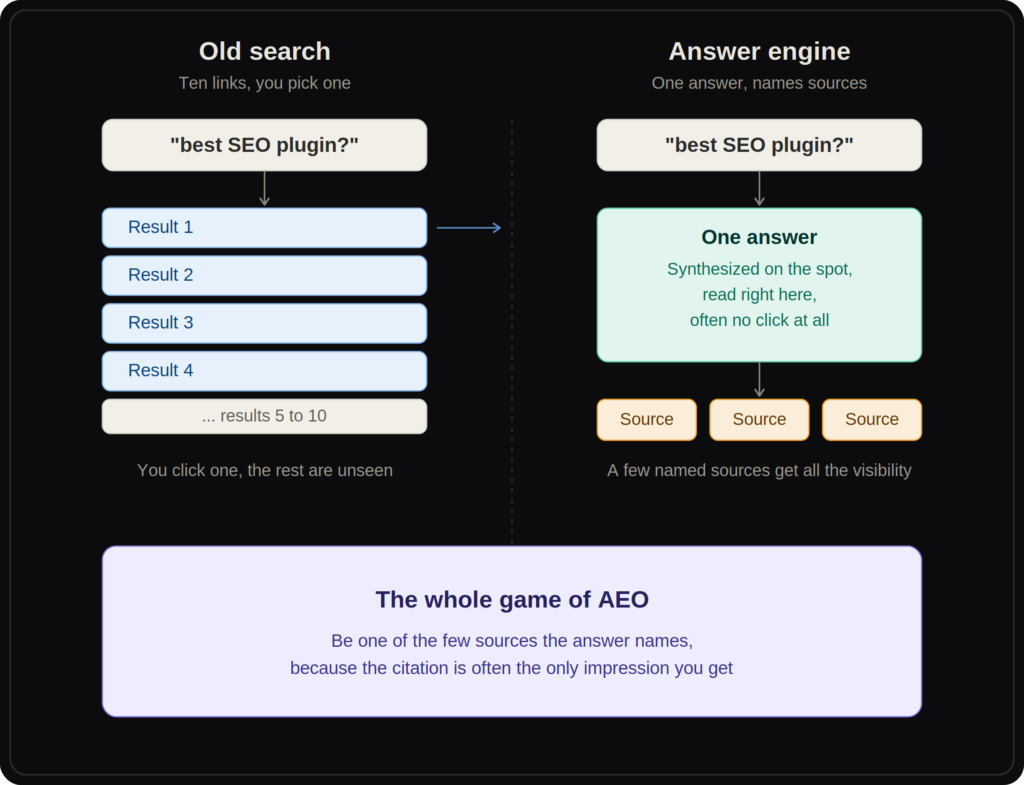
If you read nothing else, read this: the search box did not disappear, it changed shape. It used to hand you ten links and let you choose.
Now it increasingly hands you one answer and names a few sources.
The entire game of AEO is making sure your page is one of those named sources, because in a world where most searches end without a click, the citation inside the answer is often the only impression you get.
1. The shift: why AEO exists now
For twenty-five years, the deal between a website and a searcher was stable. You typed a query, a search engine returned a ranked list of links, and you clicked one.
Search engine optimization was the craft of getting your link as high on that list as possible, because higher meant more clicks, and clicks were the whole point.
That deal is breaking. Answer engines now resolve a large share of questions on the results surface itself, before anyone clicks anything.
When you ask ChatGPT a question, it does not hand you ten links. It gives you a synthesized answer and, if the engine cites its sources, names a handful of pages it drew from.
When you search a question on Perplexity, it performs a live web search, reads roughly ten pages, and builds an answer that cites three to five of them inline.
When you run many queries on Google now, an AI Overview appears above the traditional results and answers the question directly, often well enough that the searcher never scrolls to the blue links at all.
The consequence is a rise in what the industry calls zero-click search. A large and growing share of searches end without a visit to any website, because the answer arrived on the screen.
Estimates vary by study and query type, but the direction is not in dispute: for informational and question-shaped queries especially, clicks are declining as AI answers absorb them. Some analyses put the share of AI-answer sessions that end without any click extremely high.
Whatever the exact figure on a given day, the strategic reality is the same. If your visibility strategy depends entirely on earning a click, a growing slice of your potential audience is now invisible to you, because they got their answer and moved on.
This is where AEO comes from. It is the response to a simple, uncomfortable question: if fewer people click, and more people just read an AI answer, how do you stay visible?
The answer is that you stop optimizing only to be the link people click, and you start optimizing to be the source the AI quotes. That is a different job.
It requires a different way of writing, a different technical setup, and a different way of measuring success. This guide is about that job.
It is worth being honest about scale here, because hype in this space runs hot. Google still sends far more raw traffic than ChatGPT, Perplexity, Gemini, and Claude combined.
Nobody serious is telling you to abandon traditional search. The case for AEO is not that AI search has already replaced Google.
It is that AI search is growing extremely fast, that it converts at dramatically higher rates because the intent is higher, and that the brands establishing citation authority now are building a moat before most of their competitors have noticed the channel exists. The adoption gap is the opportunity.
Surveys suggest a large majority of organizations believe AI answer optimization will matter to their strategy within a few years, while only a small minority have actually started. Starting now is a first-mover advantage that will not be available for long.
There is also a quality-of-audience story that makes AEO worth more than its raw traffic numbers suggest. Multiple analytics vendors have reported that traffic referred from AI answer engines converts at strikingly higher rates than traditional organic search, in some measurements by a factor of several times.
The logic is intuitive. Someone who clicks through from an AI answer has already had their question partially resolved and is deeper into a decision.
They are not a casual browser who typed a keyword. They are a person the AI has effectively pre-qualified by handing them a considered answer and a source to verify it.
Lower volume, much higher intent. For a business, that trade is often excellent.
So AEO exists because the surface of search changed, because clicks are migrating into answers, because the traffic that does come through is unusually valuable, and because the window to establish authority in this new channel is open right now and closing gradually as awareness spreads.
Everything else in this guide is mechanics. This is the why.
2. What Answer Engine Optimization actually is
Answer Engine Optimization is the process of structuring, formatting, and supporting your content so that AI answer engines can confidently extract a clear, accurate answer from it and cite your page as the source.
Instead of optimizing primarily for rankings and clicks, AEO optimizes for being the extractable, trustworthy, machine-readable answer to a specific question.
Break that definition into its working parts, because each one is a lever you can pull.
Structuring means the physical shape of the content on the page.
Answer engines extract best from content that leads with a direct answer and then expands, that uses headings phrased as the questions people ask, and that presents information in clean, self-contained blocks rather than burying the point three paragraphs into a narrative.
A page can contain the correct answer and still lose the citation because the answer is tangled up in storytelling the engine cannot cleanly lift.
Formatting means the machine-readable signals layered onto that structure.
Schema markup in JSON-LD, particularly FAQPage and Article schema, turns your questions and answers into explicit, labeled citation candidates.
Clear headings, lists where appropriate, and tables for comparisons all help an engine parse what a given chunk of content is and whether it answers the question at hand.
Supporting means everything off the page that tells the engine your source is trustworthy. Consistent naming of your brand and its entities across the web, mentions on sites the engine already trusts, presence on review platforms, and a general reputation that lets the model resolve who you are and decide you are safe to cite.
An answer engine is, at its core, a trust machine. It is trying to give its user a correct answer without embarrassing itself, so it leans toward sources it can verify and corroborate.
Put those together and AEO is the practice of engineering a page to be found, extracted, and trusted as the answer.
The success metric is not a ranking position and it is not raw traffic.
It is citation: how often, across the questions that matter to your business, an AI answer names your page as its source.
A closely related metric is share of voice, which asks not just whether you are cited but how you stack up against competitors on the same questions.
When a buyer asks an answer engine which tool solves their problem, are you in the answer, or is a competitor there instead while you sit in a footnote no one reads?
It helps to draw the boundary of what AEO is not. AEO is not a magic bypass around good content.
If your information is wrong, thin, or unhelpful, no amount of structure will make an engine want to cite it, and increasingly the engines are good at telling the difference. AEO is not keyword stuffing with a new coat of paint.
The engines resolve meaning and entities, not keyword density, so repeating a phrase does nothing.
And AEO is not separate from SEO in the sense of being a rival discipline you choose instead.
It sits on top of SEO. The next section makes that relationship precise, because getting it right is the difference between a strategy that compounds and one that wastes effort.
One more framing that will serve you through the rest of this guide. Traditional SEO operates at the level of the page.
You optimize a page, you rank a page, you earn a click to a page. AEO operates at the level of the fact.
You are optimizing an individual claim, statistic, or answer so that when an engine needs that specific fact to build an answer, it reaches for yours and names you.
A single page might contain dozens of facts, each a potential citation for a different question.
Thinking in facts rather than pages is the mental shift that makes everything else click into place.
3. AEO vs SEO: the concrete differences
SEO optimizes a whole page to rank in a list of results and earn a click. AEO optimizes a specific fact or answer block so an AI engine extracts it and cites your page inside a generated answer.
SEO works at the page level with keywords and links as its primary currency. AEO works at the fact level with answer-first structure, schema, cited evidence, and entity clarity as its currency.
They share a foundation but aim at different targets.
The temptation is to treat these as opponents, as if you must pick a side in a war between old SEO and new AEO. That framing is wrong and it will cost you.
The two are complementary, and in fact they feed each other. Many answer engines draw heavily on pages that already rank well in traditional search.
Google AI Overviews lean on content sitting in the top organic positions. ChatGPT’s search draws substantially from Bing’s index.
Perplexity runs a live search against a massive URL index and rewards the same crawlability and quality that good SEO produces. So strong SEO is not obsolete under AEO.
It is often the precondition for AEO working at all, because a page that cannot be found and is not trusted will never be extracted no matter how beautifully you structure its answer blocks.
What genuinely differs is the optimization target and everything that flows from it. Here is the comparison in concrete terms.
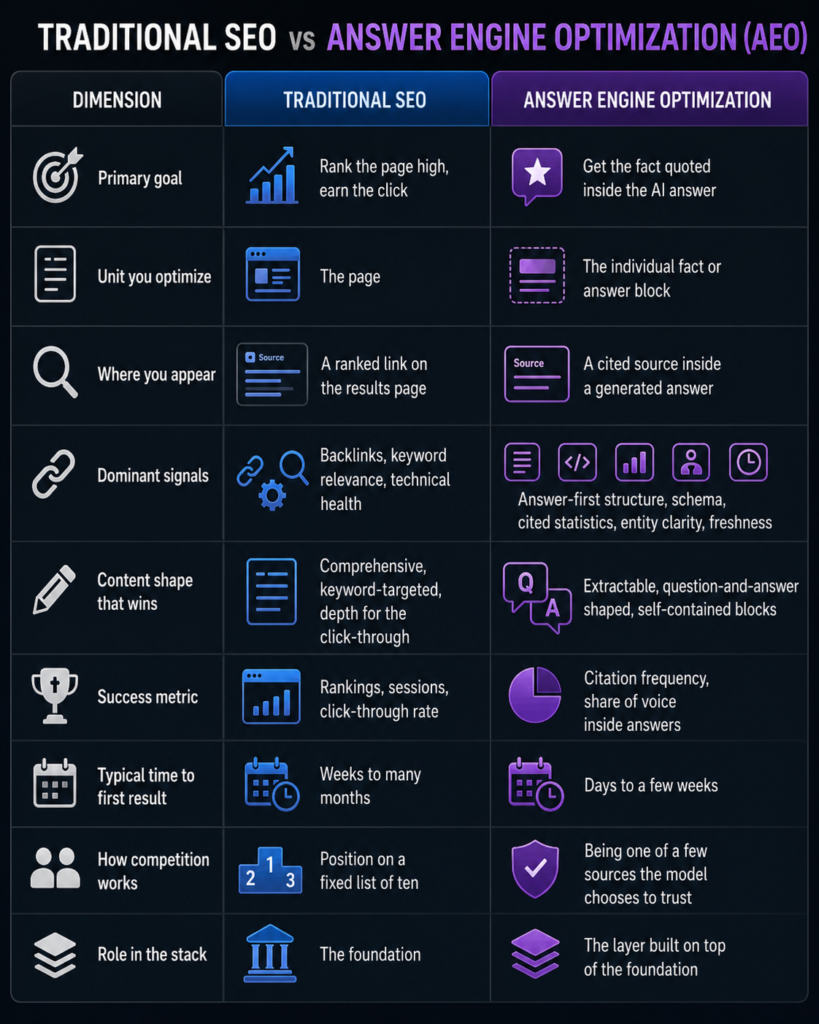
Walk through the rows that matter most.
The unit of optimization is the deepest difference. In SEO you think in pages.
You ask which page should rank for a keyword and how to make that page win. In AEO you think in facts.
You ask which specific claims and answers on your page an engine might need, and whether each one is structured to be lifted cleanly. This reframe changes how you write.
Instead of a flowing essay that makes its point somewhere in the middle, you write in extractable units, each opening with the answer, each able to stand alone if a machine quotes it without the surrounding context.
The signals differ in a way that rewards different work. SEO’s classic signals, backlinks and keyword optimization and site health, still matter as a base, but AEO adds signals that traditional SEO barely weighted.
Answer-first formatting, where the direct answer sits at the top of a section, is heavily rewarded because it matches how engines extract. Schema quality matters more, because it explicitly labels your content for machines.
Statistical density and cited evidence matter more, because engines lean toward specific, verifiable claims.
Research analyzing AEO citation signals has found that things like FAQ schema quality, answer-first formatting, and the density of cited statistics carry substantial weight in whether content gets extracted, in some analyses outweighing raw backlink counts for the specific job of AI citation.
The point is not that links stopped mattering. It is that a new set of on-page and evidence signals now sits alongside them and, for citation specifically, often matters more.
The time-to-result difference is one almost nobody talks about, and it is a gift to anyone starting from scratch. Traditional SEO is slow.
A new page on a new domain can take many months to climb, because ranking depends heavily on accumulated authority and links, which take time to earn. AEO moves far faster.
Structural changes to a page, adding an answer block, adding FAQ schema, tightening the headings into questions, tend to show up in Perplexity within roughly two to seven days and in ChatGPT within roughly seven to twenty-one days.
Google AI Overviews are slower, often four to eight weeks, and reputational signals like review-site presence can take a month or more to be ingested.
But the fast engines give you a feedback loop measured in days. You can publish, test whether you are cited within a week, and iterate.
That speed is the single most important tactical fact for a new site, and section fifteen builds an entire playbook around it.
The way competition works is different in kind, not just degree. In traditional search you are competing for position on a fixed list.
There are ten organic slots and you want to be near the top of them.
In AEO you are competing to be one of a small handful of sources the model decides to trust and quote for a given question, and that set is not a fixed ranked list.
It is chosen fresh, per query, based on which sources best and most trustworthily answer that specific question.
This is why a genuinely better, better-evidenced answer from an unknown site can beat a mediocre answer from a famous one for a specific question, in a way that is much harder in traditional ranking where the famous site’s accumulated authority tends to dominate the whole list.
The honest synthesis is this. Do not choose between SEO and AEO.
Build SEO as the foundation that gets you found and trusted, then layer AEO on top to get your found, trusted pages extracted and cited. Skipping SEO leaves you invisible to the many engines that pull from ranked content.
Skipping AEO leaves you ranking while your competitors get quoted and you get scrolled past. The winners do both, and they design each important page to satisfy both at once: comprehensive enough to rank, extractable enough to be cited.
4. AEO vs GEO vs AI SEO: untangling the terms
AEO and GEO are near-synonyms for the same practice of getting cited by AI answer engines, with GEO (Generative Engine Optimization) emphasizing the generative-AI angle and AEO (Answer Engine Optimization) tracing back to answer engines and featured snippets.
AI SEO, LLM SEO, ChatGPT SEO, and Perplexity SEO are mostly platform-flavored names for the same job.
Underneath all of them sits traditional SEO, the broader discipline of ranking in search that every one of these extends.
The terminology in this space is genuinely messy, and the mess causes real confusion, so it is worth spending a moment to make it clean.
Different vendors and writers coined different labels for overlapping ideas at roughly the same time, and marketing incentives pushed each to promote their preferred term as the important one.
The result is an alphabet soup that makes newcomers think there are five different disciplines to learn when there are really one or two ideas wearing several names.
Here is the practical map.
GEO, Generative Engine Optimization, is currently the most common umbrella term. It emphasizes that the engines in question are generative, meaning large language models that generate answers rather than retrieve links.
GEO tends to be the term of choice when people want to stress the AI and LLM angle. In practice, when someone says GEO, they mean optimizing content so that ChatGPT, Perplexity, Claude, Gemini, and Google AI Overviews cite it.
AEO, Answer Engine Optimization, describes the same practice but traces its lineage to an older idea: optimizing to be the direct answer, which predates the current AI wave. Before ChatGPT, “answer engines” already existed in the form of Google’s featured snippets, People Also Ask boxes, and voice assistants like Alexa and Siri that read a single answer aloud.
AEO grew out of optimizing for those direct-answer surfaces and expanded naturally to cover AI answer engines. So AEO carries a slightly broader connotation that includes featured snippets and voice, not only generative AI.
Then come the platform-flavored and developer-flavored synonyms. AI SEO and LLM SEO are the terms people reach for when they want to signal the technical, model-facing nature of the work.
ChatGPT SEO and Perplexity SEO are simply the practice named after the specific platform someone cares about. None of these describe a fundamentally different discipline.
They are framings.
Does the distinction between AEO and GEO matter in practice? Rarely.
For almost all real work, treat them as the same thing and pick whichever term your audience uses.
The signals that get you cited by an AI answer engine, answer-first structure, schema, cited evidence, entity clarity, freshness, and crawler access, are the same whether you call the work AEO or GEO.
Where a subtle distinction occasionally surfaces, it is that AEO’s older roots make it the more natural term when you also care about Google featured snippets and voice search, while GEO is the more natural term when your focus is squarely on large language model citations. But this is a nuance, not a fork in the road.
Do not let the vocabulary paralyze you. The job is one job: be the source the AI quotes.
One clarification that genuinely helps, because people conflate these two specifically. SEO and AEO are not the same, even though AEO extends SEO.
SEO’s goal is a ranked link and a click. AEO’s goal is a citation inside an answer.
You can rank well and rarely get cited, if your content ranks but is not structured to be extracted. You can also get cited without ranking first on the fast engines like Perplexity that run live search and weight extractability over accumulated authority.
They overlap heavily at the foundation and diverge at the target. Hold both ideas at once: same roots, different fruit.
5. How answer engines choose what to cite
Answer engines evaluate a set of candidate pages for a question and cite the few that are easiest to extract a trustworthy, relevant answer from.
They favor content that leads with a direct answer, uses question-shaped headings, carries clean schema, includes attributed statistics and evidence, names its entities clearly and consistently, stays fresh, and permits AI crawlers.
Content that buries its answer, hedges vaguely, or blocks the crawlers gets passed over regardless of how good it might be underneath.
To optimize for something, you have to understand its mechanism, so let us look at what actually happens when an answer engine responds to a question.
The details vary by platform, but the general shape is consistent across the major ones.
First, the engine interprets the question. It works out what is actually being asked, what entities are involved, and often what the underlying intent is, whether the person wants a definition, a comparison, a how-to, a recommendation, or a purchase.
Some engines expand a single question into several related sub-queries behind the scenes, a technique sometimes called query fan-out, so that the answer can be built from multiple angles.
This matters for you because it means an engine may be looking for content that answers not just the literal question but the cluster of related questions around it.
Second, the engine retrieves candidate sources.
On live-search engines like Perplexity and Google AI Mode, this is a real-time web search that pulls a set of pages, often on the order of ten, that seem relevant to the question.
On engines that lean on an existing index, the candidates come from that index, which is why ranking in Bing helps with ChatGPT and Copilot and ranking in Google helps with AI Overviews.
Either way, there is a retrieval step that decides which pages even get considered.
If your page is not retrievable, not indexed, not crawlable, blocked to the AI bot, or simply not relevant enough to surface, you are out before the real evaluation begins.
Third, the engine reads and evaluates the candidates and decides which to actually use in building the answer.
This is the crucial step and the one most people underinvest in.
Being retrieved is not the same as being cited. The engine reads the candidate pages and assesses which ones contain the clearest, most trustworthy, most extractable answer to the question.
It is looking for content it can lift a clean answer from without ambiguity, content whose claims are specific and verifiable, and content from a source it has reason to trust. The pages that best satisfy this become the cited sources woven into the generated answer.
The rest, even if retrieved, contribute nothing the reader sees.
Fourth, the engine generates the answer, weaving in the chosen sources and, on citing engines, naming them inline or as footnotes.
The reader gets a synthesized response built from a few sources, and those few sources got the only visibility that mattered for that query.
Now the practical part: what actually tips the evaluation in your favor. Research and field testing across the major engines have converged on a consistent set of signals.
A study led by researchers at Princeton found that adding citations, quotations, and statistics to content could lift its visibility in AI-generated answers by roughly thirty to forty percent, a large effect for changes that are entirely within your control.
Field analyses across multiple engines have repeatedly found that a handful of signals carry most of the weight for citation.
The direct answer block is the most important. Content that leads a section with a self-contained, roughly forty to sixty word answer to the section’s question is dramatically more extractable than content that meanders toward its point.
Engines want to lift a clean answer, and a clean answer sitting right at the top, phrased to stand alone, is exactly what they can lift. If you do one thing from this entire guide, make it this.
Question-shaped headings come next. When your heading is the literal question a user would ask, and the answer sits directly beneath it, you have created a matched pair that maps precisely onto how engines retrieve and extract.
The heading signals the question the section answers, and the answer beneath it is the extractable unit. This alignment is worth a great deal.
Schema markup, especially FAQPage and Article schema in JSON-LD, explicitly labels your content for machines.
FAQPage schema in particular turns each question and answer on your page into a discrete, machine-readable citation candidate that aligns with how conversational engines retrieve answers.
It is not a magic wand, and schema alone will not save weak content, but it is a clear, cheap signal that helps the right content get understood and extracted.
Attributed statistics and cited evidence tip the trust evaluation. Specific, sourced claims beat vague ones every time.
“Conversion improved forty-seven percent after the change” beats “conversion improved a lot,” and a statistic with an inline link to its primary source beats a bare number with no provenance.
Engines lean toward content that shows its work, because verifiable claims are safer to repeat.
Entity clarity and consistency help the engine resolve who you are and decide you are trustworthy.
When your brand, product, people, and key concepts are named clearly and consistently across your site and the wider web, the engine can build a confident model of the entity and is more willing to cite it.
Ambiguity, where the engine cannot tell exactly what or who a source is, works against citation.
Freshness matters, more on some engines than others. Visible, honest signals that content is current, real “last updated” dates backed by real updates, push engines toward citing you for time-sensitive questions.
Perplexity in particular weights recency heavily.
And crawler access is the binary gate under everything. If your robots.txt blocks the AI crawlers, you are invisible to those engines no matter how perfect everything else is.
This is a small signal in the sense that it is one line in a file, but it is binary: blocked means zero. Section ten covers exactly which crawlers to allow.
The mental model to carry away is that an answer engine is a cautious librarian trying to answer a patron’s question without being wrong. It wants sources it can find, understand, extract cleanly, and trust.
Every AEO tactic in this guide is really about making your page easier to find, easier to understand, easier to extract, and easier to trust than the alternatives. Get those four right and citations follow.
6. Platform by platform: how each engine behaves
No single answer engine behaves like the others, and one page rarely wins all of them.
Only about eleven percent of domains are cited by both ChatGPT and Perplexity, which tells you plainly that each engine has its own tilt and its own path to citation.
Optimizing for one is not the same as optimizing for all, so a serious AEO strategy accounts for the differences. Here is how the major engines actually behave in 2026.
ChatGPT is the largest by usage and leans encyclopedic. Its search capability draws substantially from Bing’s index, with studies finding a high overlap between Bing’s top results and ChatGPT’s citations.
This has a direct practical consequence: if you want to be cited by ChatGPT’s search, being indexed and ranking in Bing matters, and most content teams never even verify their site in Bing Webmaster Tools.
ChatGPT tends to cite fewer sources per answer than some engines but to extract more deeply from the ones it does cite, so when it names you, the citation tends to carry real weight.
It favors comprehensive, authoritative, well-structured content. Brand mentions across the web are among the strongest predictors of whether ChatGPT cites a given brand, which points to the off-page work covered in section twelve.
Structural changes typically surface in ChatGPT on the order of one to three weeks.
Perplexity is the engine built around citation, and for AEO it is often the best place to start because its behavior is the most transparent and its feedback loop is the fastest.
Every query triggers a real-time web search against a very large URL index, it reads roughly ten pages, and it cites three to five of them inline, with citation density often running higher than that across a full answer.
It weights freshness and concrete examples heavily. Because it searches live and rewards extractability over accumulated domain authority, Perplexity is the engine where a new, well-structured, well-evidenced page can get cited fastest, sometimes within days.
Perplexity also draws notably on community content, with Reddit consistently among its most-cited sources, which is why genuine community presence is a real Perplexity tactic and not an afterthought. If you want a fast signal that your AEO work is landing, test on Perplexity first.
Google AI Overviews and AI Mode sit on top of Google’s own index and lean on pages that already rank well organically.
A meaningful share of AI Overview citations come from pages sitting in the top organic positions, with the rest increasingly drawn from authoritative niche sources.
The practical implication is that for Google’s AI surfaces, traditional SEO and AEO are tightly coupled: ranking well is a strong path into the AI Overview, and structuring that ranking content answer-first improves the odds of being the cited source rather than just one of the ranked links below the fold.
Google’s AI surfaces are slower to reflect changes, often four to eight weeks, in line with normal Google indexing cadence.
When AI Overviews appear, they meaningfully reduce clicks to even the top organic result, which is precisely why being the cited source inside the Overview, not merely the link beneath it, is the goal.
Claude is a large and growing answer surface with live web search, and the same fundamentals that help elsewhere, answer-first structure, schema, E-E-A-T signals, entity clarity, help here too.
Claude and Google AI Overviews tend to be somewhat slower to reflect new content than Perplexity and ChatGPT, often two to six weeks for structural changes to show up, so patience is required, but the underlying optimization is the same discipline.
Gemini is Google’s conversational model and benefits from the same Google-ecosystem coupling as AI Overviews, plus its own conversational retrieval.
Strong organic presence and clean structure both help.
Microsoft Copilot runs on GPT models and retrieves candidates from Bing’s index, so its citation path has two gates: your site needs to be indexed and ranking in Bing, and then the page needs to be structured clearly enough for a clean extraction.
The strategic upside is that Copilot is meaningfully less contested than ChatGPT or Google, because most teams optimize only for Google and ignore Bing entirely.
That neglect lowers the bar. Microsoft has also added AI performance reporting in Bing Webmaster Tools that can show which of your pages are cited in Copilot responses, making it one of the few engines with any built-in first-party citation visibility.
Grok is distinctive because of its dual sourcing: it pulls from both the live web and real-time posts on X, and it weights freshness heavily.
That means an active, current presence on X can directly influence whether Grok cites you, which is a platform-specific optimization that does not carry over from the others.
The general fundamentals still apply, but the X presence is the Grok-specific lever.
The takeaway across all of them is coverage plus specialization.
Because the engines overlap so little in which domains they cite, and because each has its own tilt, the brands that win broad AI visibility do not optimize for one engine.
They get the universal fundamentals right, answer-first structure, schema, evidence, entity clarity, freshness, crawler access, and then add the engine-specific moves that matter for the platforms they care most about:
Bing indexing for ChatGPT and Copilot, freshness and community presence for Perplexity, organic ranking for Google’s AI surfaces, and an active X presence for Grok. You do not have to chase every engine equally.
But you should know that they are different, and choose deliberately where to specialize.
7. The two gates: retrieval and absorption
Getting cited by an answer engine requires passing two separate gates, and most content fails at the second one. The first gate is retrieval, being found and selected as a candidate source for the question.
The second gate is absorption, having evidence strong enough that your content actually shapes the answer the reader sees, rather than sitting as an unread footnote. Passing the first without the second is the most common and most invisible AEO failure.
This two-gate model, articulated clearly in analyses of how Perplexity and similar engines work, is the single most useful frame for diagnosing why AEO efforts underperform, so it is worth understanding deeply.
Consider what retrieval requires. To be retrieved, your page has to exist in the pool the engine draws from.
On a live-search engine that means being crawlable, indexed, relevant to the query, and permitted to the AI crawler. On an index-based engine it means ranking well enough in the underlying index, Bing for ChatGPT and Copilot, Google for AI Overviews, to be in the candidate set.
Retrieval is largely a traditional-SEO and technical-access problem. It is about findability and relevance.
Most competent sites can pass the retrieval gate with good SEO fundamentals and open crawler access.
Now consider absorption, which is where the real contest happens and where most content quietly loses.
Being retrieved means the engine looked at your page.
Absorption means the engine actually used your content to build its answer, that your evidence was strong and clear enough to shape what the reader reads and to earn the citation attached to it.
The common, painful failure mode is this: your page is retrieved and appears as a source, a little footnote number, but a competitor’s content actually shapes the answer.
The reader reads the competitor’s framing, absorbs the competitor’s facts, and forms an impression driven by the competitor, while your citation sits there unread. You technically got cited and it did you almost no good, because you did not shape the answer.
What decides absorption? Evidence quality and extractability, above all.
The two highest-leverage signals for absorption are query-specific answer blocks and original, first-party proof. A query-specific answer block is content that directly and cleanly answers the exact question, positioned to be lifted.
Original first-party proof is evidence nobody else has, your own data, your own research, your own specific numbers, which the engine cannot get from a competitor and therefore must attribute to you if it uses it.
Generic summaries of other people’s research fail absorption, because the engine has many interchangeable sources for generic information and no particular reason to let yours shape the answer or earn the citation.
When your content is the only place a specific, useful fact lives, the engine has no choice but to absorb and attribute it to you.
This is why original data is repeatedly singled out as the strongest citation magnet in the entire discipline.
If you publish a statistic, a study, or a data point that exists nowhere else and is genuinely useful for answering a question, you have created content that clears the absorption gate by construction.
The engine wants that fact, only you have it, so it uses it and names you. Everything else, structure and schema and freshness, improves your odds.
Original proof changes the odds categorically.
The diagnostic value of the two-gate model is that it tells you where to look when AEO is not working.
If you are not cited at all, you probably have a retrieval problem: you are not being found or considered, so check crawlability, indexing, AI crawler access, and basic relevance and authority.
If you are cited but it is not driving anything, and you notice competitors’ framing dominates the answers where you appear as a footnote, you have an absorption problem: your evidence is not strong or specific or extractable enough to shape the answer, so invest in sharper answer blocks and, above all, original proof. Two different failures, two different fixes.
Diagnose which gate you are failing before you spend effort, because optimizing the wrong gate wastes time.
8. On-page AEO: structuring content to be extracted
On-page AEO is the practice of shaping the content on the page itself so answer engines can extract it cleanly.
The core moves are leading every section with a direct forty to sixty word answer, phrasing headings as the questions people actually ask, writing in self-contained extractable blocks, using lists and tables where they aid parsing, front-loading specifics and evidence, and keeping each answer able to stand alone if a machine quotes it without context.
This is where most of the winnable work lives, and it is entirely within your control.
Start with the answer-first block, because it is the foundation everything else sits on.
For every section of a page, and for the page as a whole, lead with a direct answer of roughly forty to sixty words that resolves the question with no preamble.
Not a throat-clearing introduction, not “in this section we will explore,” but the actual answer, stated plainly, immediately. Then expand beneath it with the context, nuance, examples, and depth that a human reader who wants more will value.
This structure serves two masters at once. The engine gets a clean, liftable answer at the top.
The human who clicks through gets the depth below. You are not choosing between machine-extractability and human value.
The answer-first-then-expand structure delivers both, and it is the single highest-return habit in on-page AEO.
The reason the forty to sixty word range works is practical. It is long enough to actually answer a question completely and short enough to be a clean, self-contained unit an engine can lift without dragging in surrounding context.
Much shorter and the answer is often incomplete. Much longer and it stops being an extractable atom and becomes a paragraph the engine has to summarize, which introduces the risk that it summarizes using a competitor’s clearer version instead.
Aim for complete but tight.
Next, phrase your headings as questions. Real questions, phrased the way a person would actually ask them, ideally the way they would ask an answer engine.
Instead of a heading like “Optimization Techniques,” use “How do you optimize content for AI answer engines?”
The question heading paired with the answer block beneath it creates the matched question-and-answer unit that maps precisely onto how engines retrieve and extract.
It also, as a bonus, tends to match the long-tail, conversational queries people type and speak, which helps with traditional search and featured snippets too.
Question headings are a rare tactic that helps SEO, AEO, and voice search simultaneously.
Write in self-contained blocks. Because an engine may lift any single chunk of your content and drop it into an answer with no surrounding context, each chunk should make sense on its own.
Avoid answers that depend on “as mentioned above” or “building on the previous point,” because when the engine extracts that block in isolation, the reference is dangling and the meaning breaks.
Each answer block should be intelligible if it were the only thing a reader saw.
This is a discipline that feels slightly repetitive to write, because you sometimes restate context you already established, but it is exactly what makes content robustly extractable.
Use lists and tables where they genuinely aid parsing. A comparison is clearer as a table than as prose, and engines can extract structured comparisons cleanly.
A sequence of steps is clearer as a numbered list. Do not force everything into lists, prose is better for explanation and nuance, but where the information is genuinely structured, structure it.
Structured presentation is easier for a machine to parse and reuse, and it tends to be easier for humans to skim, which is its own reward.
Front-load specifics and evidence within each block. Vague claims are weak citation candidates; specific, sourced claims are strong ones.
Wherever you can replace a general statement with a specific one, do it, and wherever you make a factual claim that has a source, cite the source inline. “AI-referred traffic converts better” is weak.
“AI-referred sessions have been measured converting several times higher than traditional organic, with one set of vendor data putting the gap at roughly fourteen percent versus under three percent” is strong, because it is specific and attributable.
The specificity is not just more credible to humans; it makes the claim more extractable and more attributable, which improves both citation and absorption.
Keep answers honest and hedge only where honesty requires it. Engines are increasingly good at detecting overclaiming, and content that overstates tends to be a worse citation candidate than content that states the honest, bounded truth.
Where the real answer is “it depends” or “not reliably yet,” say so clearly and then explain the conditions.
Counterintuitively, the honest, appropriately-hedged answer often gets cited more than the confident-but-wrong one, because the engine is trying not to be wrong and rewards sources that are accurate about their own limits.
Honesty is not just ethical here; it is an extraction advantage.
Finally, structure the whole page as a coherent answer to a primary question, with sections answering the natural sub-questions around it.
Because engines often fan a single question out into related sub-queries, a page that comprehensively covers the cluster of questions around a topic, each in its own answer-first section, is positioned to be the source across many related queries, not just the literal headline one.
This is where on-page AEO and topical depth meet: a thorough, well-structured page is both a better citation candidate and a better ranking candidate, satisfying both gates and both disciplines at once.
9. Schema and structured data for answer engines
Schema markup is code you add to a page, usually as JSON-LD, that explicitly tells machines what your content is and means.
For AEO, the schema types that matter most are FAQPage, which turns each question and answer into a discrete machine-readable citation candidate, and Article, which labels your content as an article with an author, publisher, and dates.
Schema does not rescue weak content, but it is a cheap, clear signal that helps good content get understood and extracted.
Think of schema as leaving labeled notes for the machine. Without it, an engine has to infer what your content is from the raw text and layout.
With it, you are handing the engine an explicit, structured description: this block is a question, this block is its answer, this is the article’s author, this is when it was last updated.
That explicitness reduces ambiguity, and reduced ambiguity helps the right content get extracted for the right query.
FAQPage schema is the workhorse of AEO. When you mark up a genuine question-and-answer section with FAQPage schema, each question becomes an explicit citation candidate that aligns precisely with how conversational engines retrieve answers.
A user asks a question, the engine looks for content structured as an answer to that question, and your FAQPage-marked Q and A is exactly that, labeled and ready.
One important caveat: the questions and answers must genuinely appear on the page and genuinely be useful.
Schema is a description of real content, not a place to stuff invisible keywords, and marking up content that is not really there or not really helpful invites problems rather than citations. Mark up real, on-page, useful Q and A, and it becomes strong citation fuel.
Article schema labels the page as an article and carries the metadata engines and search systems use to assess and attribute it: the headline, the author, the publisher, the date published, and, critically, the date modified.
That date-modified field is your freshness signal in structured form.
Keeping it accurate and current on every real update tells machines the content is maintained, which supports citation for time-sensitive questions.
Article schema also supports the broader entity and authority picture by naming the author and publisher explicitly, which helps engines resolve who stands behind the content.
Beyond those two, other schema types matter depending on what you publish.
Organization schema helps engines resolve your brand as an entity, connecting your name, logo, and official links so the model can confidently identify who you are.
For software and tools, SoftwareApplication schema describes the product.
HowTo schema, where genuinely applicable, structures step-by-step instructions, though it should only be used for real procedural content.
Breadcrumb schema clarifies site structure. The principle across all of them is the same: use the schema type that honestly describes your content, implement it in clean JSON-LD, and keep it accurate.
Schema is a machine-readable statement of fact about your page, and like any statement of fact in AEO, it works when it is true and specific and backfires when it is inflated.
A practical note on implementation. JSON-LD is the preferred format because it sits in a script block in the page’s head or body without tangling into the visible markup, which makes it easy to add, maintain, and validate.
After adding schema, validate it, using a structured-data testing tool, to confirm it parses correctly and contains no errors, because broken schema can be worse than no schema.
Aim for a clean pass on the schema types that matter for your pages: Article and FAQPage for content, Organization for your brand, and SoftwareApplication if you have a product.
On WordPress, quality SEO plugins can generate and manage much of this for you, which section fourteen covers, but the underlying principle holds regardless of how you implement it: label your content honestly and clearly for machines, and the right machines will understand and extract it.
10. Technical AEO: crawlers, llms.txt, freshness, and access
Technical AEO is the layer that determines whether engines can access and trust your content at all.
The essential moves are allowing the major AI crawlers in robots.txt, maintaining genuine freshness signals, ensuring fast and clean rendering so content is actually readable by machines, and understanding what llms.txt is and is not.
Get the access layer wrong and nothing else matters, because a page an engine cannot reach or read cannot be cited.
The most important and most overlooked piece is AI crawler access. Answer engines send their own crawlers to read the web, and if your robots.txt blocks them, you are invisible to those engines completely, no matter how good your content and structure are.
This is a binary gate: blocked means zero citations from that engine.
The crawlers you generally want to allow include GPTBot and OAI-SearchBot from OpenAI, PerplexityBot from Perplexity, ClaudeBot from Anthropic, Applebot which serves Apple’s intelligence features, and Google’s crawlers which handle AI Overviews through the normal Googlebot access.
Check your robots.txt and confirm none of these are disallowed. Many sites block AI crawlers by accident, through an overly aggressive rule, a security plugin’s default, or a copied robots.txt from a source that blocked them deliberately, and then wonder why they are absent from AI answers.
This is the first thing to check and the easiest to fix, and it is worth checking periodically because plugins and hosts sometimes change defaults.
There is a genuine strategic decision buried in crawler access, and honesty demands acknowledging it. Allowing AI crawlers means allowing your content to be used in AI answers, sometimes without a click back to you.
Some publishers choose to block AI crawlers to protect their content, and that is a legitimate choice with real trade-offs. But if your goal is AEO, if you want to be cited and to build visibility in AI answers, you must allow the crawlers.
You cannot be cited by an engine you have locked out. For most businesses using content to build awareness and drive consideration, the visibility is worth far more than the protection, but it is a real decision and you should make it deliberately rather than discover an accidental block months later.
Freshness is a real technical and content signal, weighted especially heavily by Perplexity and Grok.
The practical implementation is honest date signals: a visible “last updated” date on the page, backed by a matching date-modified field in your Article schema, backed by actual updates to the content.
The key word is honest. Slapping a current date on stale content is the kind of manipulation engines increasingly detect and distrust, and it erodes the credibility that earns citations.
Real freshness means genuinely maintaining your important pages, updating facts and figures as they change, and reflecting that maintenance in visible and structured dates. For time-sensitive topics especially, a genuinely maintained page beats a stale one for citation, so freshness is not a one-time setup but an ongoing discipline.
This is also why AEO rewards a maintenance mindset: the discipline notes that a large share of cited sources change from month to month as models update and competitors adapt, so the sources that sustain citation treat updating as routine, not occasional.
Rendering and speed matter because an engine has to actually read your content.
If your important content only appears after heavy JavaScript execution that a crawler may not run, or if your page is so slow or broken that crawlers struggle, your content may effectively be invisible even though a human browser eventually shows it.
The safe path is ensuring your core content is present in the initial HTML and that the page renders cleanly and reasonably fast.
This overlaps heavily with traditional technical SEO, which is another reminder that good SEO fundamentals underpin AEO.
A page that is technically healthy for SEO is generally technically healthy for AEO.
Then there is llms.txt, which deserves a clear and honest treatment because it is surrounded by confusion. llms.txt is a proposed convention, a file you place on your site intended to give large language models a curated, machine-friendly guide to your most important content, somewhat analogous to how robots.txt guides crawlers or a sitemap guides indexers.
The honest status as of 2026 is that it is a proposed standard with no standards-body backing, and no major AI provider has publicly confirmed reading it in production.
In other words, adopting llms.txt is low-cost and potentially useful if the convention gains traction, but you should not treat it as a proven citation lever, and you should be skeptical of anyone who presents it as essential or guaranteed.
Add it if you like, because it is cheap and harmless and might matter later, but do not mistake it for the work that actually drives citations today, which is structure, evidence, entity clarity, freshness, and access.
This honest framing is itself worth publishing, because so much content overstates llms.txt, and being the source that tells the truth about it is exactly the kind of accurate, bounded answer that earns citations.
11. Entities, authority, and the trust layer
An answer engine will not cite a source it cannot identify or does not trust, so a large part of AEO is the trust layer: making your brand and its key concepts resolvable as clear entities, and building the authority signals that make an engine confident you are safe to quote.
This is where AEO connects to reputation, and where the work extends beyond any single page into how your brand exists across the whole web.
Entities are the people, organizations, products, and concepts an engine recognizes as distinct things with attributes and relationships.
When an engine can confidently resolve “who or what is this source,” connecting your brand name to your site, your logo, your official profiles, your products, and your area of expertise, it can model you as a known entity and is far more willing to cite you.
When it cannot, when your brand is ambiguous, inconsistently named, or thinly represented, the engine has a weaker basis for trust and citation. Entity clarity is therefore foundational, and it is built through consistency and corroboration.
Consistency means naming your brand, products, and key concepts the same way everywhere: on your own site, in your schema, on your social and review profiles, and anywhere else you appear. Inconsistent naming fractures the entity in the engine’s model.
Corroboration means the same accurate information about you appearing across multiple independent sources, so the engine sees agreement and gains confidence. This is why entity-building is partly an off-page activity, covered next, and partly an on-page one through Organization schema and consistent, clear self-description.
Authority in the AEO sense overlaps with but is not identical to traditional SEO authority. Backlinks still matter, both as a traditional signal and because they contribute to how the wider web references you.
But for AEO specifically, a broader set of trust signals matters: brand mentions across the web, whether linked or not, are especially important to language models, which often lean on recognizable, frequently-mentioned brands when generating answers. Presence on trusted third-party platforms, review sites, reputable industry publications, and well-regarded community spaces contributes to the consensus an engine builds about you.
E-E-A-T signals, experience, expertise, authoritativeness, and trustworthiness, expressed through clear authorship, credentials, sourcing, and a generally trustworthy presentation, feed the trust evaluation. The engine is trying to decide whether you are a source it can stand behind, and every signal that says “this is a real, expert, well-regarded entity” pushes toward yes.
The practical synthesis is that the trust layer is built on two pillars: be clearly identifiable, and be well-regarded. Clearly identifiable comes from consistency and structured self-description.
Well-regarded comes from genuine authority and reputation across the web. Neither can be faked cheaply, which is precisely why they carry weight.
And both compound over time, which is why a patient, consistent approach to entity clarity and authority pays off increasingly as the months pass and the engines’ model of your brand grows more confident.
12. Off-page AEO: brand mentions, Reddit, and consensus
Off-page AEO is the work that happens away from your own site to build the reputation and consensus that make engines trust and cite you. The core mechanism is that answer engines build confidence in a source by seeing agreement across multiple independent places, so the practical moves are earning brand mentions on trusted sites, maintaining genuine presence in high-authority communities like Reddit, getting listed on the review platforms engines lean on, and generally making your brand appear consistently and positively across the web.
The consensus mechanism is the key insight. When an answer engine considers recommending or citing a brand, it does not rely on a single source.
It effectively scans for agreement across many independent places, and gains confidence when a brand appears consistently, with similar positioning, across a range of trusted sources: community discussions, review sites, industry publications, and the brand’s own site. If your product shows up consistently across Reddit threads, YouTube discussions, reputable publications, review platforms, and your own well-structured pages, all telling a coherent story, the engine gains confidence and is more likely to cite and recommend you.
If you exist only on your own site, with no corroboration anywhere else, you are a weaker candidate no matter how good that site is, because the engine has no external agreement to lean on.
Brand mentions across the web are, for this reason, among the strongest signals in AEO, and notably they matter whether or not they are links. A language model that repeatedly encounters your brand mentioned in relevant contexts builds a stronger association between your brand and its area, and is more likely to surface you when that area comes up.
This reframes a lot of off-page work: it is not only about link-building in the classic SEO sense but about earning genuine mentions and presence in the places that matter, linked or not. Being talked about accurately and often, in the right contexts, is itself an AEO asset.
Reddit deserves specific attention because of its outsized role. Across the major answer engines, and Perplexity especially, Reddit is consistently among the most-cited domains, in some analyses the single most-cited source.
The engines lean on Reddit because it contains authentic, experience-driven, question-and-answer-shaped discussion, exactly the kind of first-hand content that answers real questions, and because major AI companies have invested heavily in access to its data. For AEO, this makes genuine Reddit presence a real tactic, but with a sharp caveat: it must be genuine.
Overtly promotional posts get downvoted, ignored, and can damage your brand. The approach that works is authentic participation, contributing real value in relevant communities, answering questions helpfully, and referencing your expertise or content only where it genuinely helps.
Contribute first, and let the occasional relevant mention emerge from a foundation of real usefulness. Done right, community presence builds both the consensus signal and the direct citation surface, because your helpful Reddit answers can themselves become cited sources.
Review platforms are the other high-leverage off-page surface, because engines lean on them heavily for anything resembling a product or service recommendation. Getting listed and actively managed on the review sites that engines cite, with genuine reviews accumulating over time, feeds directly into whether you appear when someone asks an engine which tool or service solves their problem.
This is slower-burning than content work, reputational signals can take a month or more to be ingested by models, so it is worth starting early and treating as a long-term foundation rather than a quick win.
The honest summary of off-page AEO is that it is reputation work, and reputation cannot be shortcut. The engines are deliberately trying to cite sources that the wider web corroborates, precisely so they can avoid citing unreliable ones, which means the path to being corroborated is genuinely earning that corroboration: real mentions, real community value, real reviews, real presence.
This is slower and harder than on-page work, which is exactly why it is defensible. Anyone can add an answer block.
Building genuine consensus across the web takes sustained, authentic effort, and that effort compounds into a moat.
13. Measuring AEO: metrics that actually mean something
Measuring AEO is harder than measuring SEO because the results hide inside answers you cannot directly see, but it is not impossible. The metrics that actually mean something are citation frequency, how often you are named as a source across the questions that matter; share of voice, how you compare to competitors on those questions; AI-referred traffic and its conversion quality; and time-to-citation, how fast new content gets picked up.
Rankings and raw traffic, the classic SEO metrics, tell you little about AEO on their own.
Start with citation frequency and share of voice, because they are the core AEO metrics and the ones most people never track. The practical method, in the absence of perfect tooling, is a structured manual audit: take a set of fifteen to twenty questions that matter to your business, the questions a potential customer would actually ask an answer engine, and run them across the major engines, ChatGPT, Perplexity, Claude, and Google AI Mode, on a regular cadence, monthly is reasonable.
For each question, record whether you are cited, whether competitors are cited, and who actually shapes the answer. Over time this gives you a real picture: your citation frequency, your share of voice against named competitors, and which questions you own versus which a competitor owns.
It is manual and imperfect, but it measures the thing that actually matters, and the discipline of doing it monthly surfaces trends you would otherwise miss. Dedicated AI-visibility tools exist to automate parts of this, and they are worth evaluating as the category matures, but the manual audit is available to anyone today and is better than flying blind.
AI-referred traffic is measurable in your analytics, and it is worth setting up deliberately. Configure your analytics to track referrals from the AI engines, traffic arriving from chatgpt.com, perplexity.ai, claude.ai, and the others, so you can see the clicks that do come through from AI answers.
The important discipline here is to watch conversion quality, not just volume. AI-referred traffic will look small next to Google organic in raw numbers, and if you judge it on volume alone you will undervalue it.
But it typically converts at dramatically higher rates, because the visitors are pre-qualified by the answer they already received. So track the volume, but weight the conversion rate heavily, because a small stream of high-converting, high-intent visitors is often worth more than a large stream of low-intent ones.
Judge the channel on the value it produces, not the raw sessions.
Time-to-citation is the metric that matters most when you are new and building, and it is your fastest feedback loop. When you publish or significantly update a page, note the date, then test the target questions on the fast engines over the following days and weeks and record when you first get cited.
Perplexity often responds within days, ChatGPT within a few weeks. Tracking time-to-citation tells you whether your AEO work is landing, gives you an early signal long before any traffic or ranking movement, and, as it tightens over time, indicates that your growing authority is making you a faster and easier source to trust.
It is the metric that keeps momentum during the long stretch before traditional rankings arrive.
A few first-party tools help. Microsoft’s Bing Webmaster Tools added AI performance reporting that can show which of your pages are cited in Copilot responses and which queries triggered them, one of the few genuine first-party citation signals available.
Beyond that, the measurement discipline is largely manual auditing plus analytics tracking plus, increasingly, dedicated third-party visibility tools. The key mindset shift is away from the SEO habit of obsessing over rankings and raw traffic and toward the AEO reality of tracking citations, share of voice, and conversion quality.
Do not judge an AEO strategy by week-two traffic. Judge it by whether, over weeks and months, you are increasingly the cited source for the questions that matter and whether the traffic that results converts.
Those are the metrics that mean something.
14. AEO for WordPress specifically
WordPress powers a large share of the web, and it is an unusually good platform for AEO because the on-page and technical work AEO requires can be handled systematically through the platform and its plugins. The core WordPress AEO moves are structuring posts and pages answer-first, generating FAQPage and Article schema, ensuring AI crawler access in robots.txt, maintaining honest freshness through post updates, and using a capable SEO plugin to manage the technical and schema layer at scale.
The content work in WordPress is the same discipline described throughout this guide, applied within the editor. Lead posts and their sections with answer-first blocks.
Phrase your headings, which WordPress structures as H2 and H3 blocks, as real questions. Write in self-contained, extractable chunks.
Build genuine FAQ sections into your important posts. Keep a visible last-updated indication and actually update the content.
None of this is WordPress-specific in principle, but WordPress makes it straightforward to apply consistently across a whole site because of its structured editor and templating.
The technical and schema layer is where WordPress plugins earn their value, because doing this by hand across many pages is tedious and error-prone. A capable SEO plugin can generate Article and FAQPage schema from your content, manage the metadata engines read, help with robots.txt and crawler directives, produce and maintain sitemaps, and generally handle the machine-readable layer so you can focus on the content.
The AEO-specific requirement is that the plugin should support the schema and structure that answer engines reward, not only traditional SEO basics, and increasingly plugins are adding explicit AEO and GEO capabilities: FAQ and answer-block support, AI crawler management, and even scoring of how well your content is structured for AI citation.
This is precisely the gap XypherSEO was built to fill. It scores WordPress content across three dimensions, classic SEO, AEO, and GEO, on a framework called AECS (Answer, Entity, Cluster, Structure), so that instead of guessing whether a page is structured for AI citation, you get a concrete score and specific fixes.
It handles the answer-first structuring signals, generates the schema, manages AI crawler access, and checks the technical foundations that determine whether engines can reach and trust your content. The point of naming it here is not a pitch so much as an illustration: the AEO work this guide describes is systematic and checkable, and on WordPress it can be scored and managed rather than left to intuition.
Whether you use XypherSEO or another capable tool, the principle is that WordPress lets you operationalize AEO across your whole site rather than hand-crafting each page, and that operational consistency is a real advantage on a platform that already handles a large share of the world’s content.
15. The zero-authority playbook: winning when you are new
A brand-new site with no authority cannot outrank established competitors in traditional Google search quickly, but it can win AI citations far faster, because AI citation weights extractability, evidence, and clarity more heavily than domain age. The zero-authority playbook is therefore to target AI citation as the fast primary objective while traditional rankings build slowly underneath, to lead with original data that clears the absorption gate by construction, and to use the days-long feedback loop of the fast engines to iterate rapidly.
This is the most important section for anyone starting from zero, so let us be precise about why it works and how to execute it. The reason a new site can win citations while it cannot win rankings comes down to how the two systems weight authority.
Traditional Google ranking leans heavily on accumulated domain authority and backlinks, which by definition a new site lacks and cannot quickly acquire, so a new site is structurally disadvantaged in ranking no matter how good its content. AI citation, especially on live-search engines like Perplexity, weights the qualities of the specific answer, its extractability, its evidence, its clarity, its freshness, much more heavily and accumulated authority much less.
This means a genuinely superior answer from an unknown site can be chosen over a mediocre answer from a famous one for a specific question, in a way that is far harder in ranking. The new site’s disadvantage is smaller, and sometimes absent, in the citation game.
The first move in the playbook is to accept the sequencing honestly. Do not measure success by traffic or rankings in the early months, because those will be quiet, and judging by them will make you abandon a strategy that is actually working.
Measure by citation and time-to-citation. When you publish a well-structured, well-evidenced answer and Perplexity cites it within a week, that is the win, even though your Google traffic is still near zero.
The rankings compound slowly underneath while the citations accrue quickly on top. Getting this sequencing right psychologically is half the battle, because the strategy only pays off for those who do not quit during the quiet early stretch.
The second move is to lead with original data, because it is the single most powerful lever available to a new site. Recall the absorption gate: generic content fails it because the engine has many interchangeable sources, but original first-party data clears it by construction because only you have the fact.
A new site cannot out-authority the incumbents, but it can out-original them. Publish data nobody else has.
Run an analysis, conduct a small study, gather and share specific numbers from your own work or tools, and structure that data to be extractable. When your page is the only place a useful, specific fact lives, the engines must attribute it to you when they use it, and your lack of domain authority becomes nearly irrelevant for that fact.
This is how a nobody gets cited next to the giants: not by being more authoritative, but by being the origin of something specific and useful.
The third move is to exploit the fast feedback loop. The incumbents move slowly and often rest on their authority; a new, hungry site can iterate faster than they bother to.
Publish an answer-first, well-evidenced page, test the target questions on Perplexity and ChatGPT within days, see whether you are cited, and if not, sharpen the answer blocks, add more specific evidence, improve the structure, and test again. This tight loop, publish, test, iterate, measured in days rather than the months of traditional SEO, lets a new site rapidly find what earns citations and double down.
The engines’ speed is the new site’s friend.
The fourth move is to pick winnable questions. Do not open by fighting for the single most contested head term against every well-funded competitor.
Target the specific, high-intent, lower-competition questions in your niche where a genuinely better answer can win, and build outward from there. As you accumulate citations on the winnable questions, your entity clarity and authority grow, and you become able to contest bigger questions over time.
Start where you can win, prove the model, and expand.
The fifth move is to build the trust layer in parallel, patiently. While the content and citations accrue, do the slower off-page work: consistent entity naming, genuine community presence, review-platform listings, real mentions.
These compound over months and gradually lift you from a site that wins the occasional citation on the strength of a specific answer to a recognized entity the engines trust broadly. The content wins get you started fast; the trust layer makes the wins durable and broad.
Put together, the zero-authority playbook is a coherent strategy that turns the apparent disadvantage of being new into a workable position: accept that rankings come slow and citations come fast, lead with original data to clear absorption, iterate rapidly using the days-long feedback loop, target winnable questions first, and build the trust layer patiently in the background. It is genuinely achievable to be cited by major AI answer engines within weeks of starting, from zero, if you execute this, because the citation game does not gatekeep on domain age the way ranking does.
That is the opening, and it is open right now.
16. Common mistakes that kill citations
Most AEO failures come from a short list of avoidable mistakes: treating AEO as separate from SEO, chasing volume over quality, burying the answer, faking data or overclaiming, blocking AI crawlers by accident, ignoring the off-page trust layer, optimizing for one engine and assuming the rest follow, and giving up before the strategy has had time to work. Avoiding these accelerates results more than any clever tactic.
Treating AEO as separate from SEO is the most common strategic error. AEO is an extension of SEO, not a replacement, and the two share a foundation.
Teams that abandon SEO fundamentals in a rush toward AEO undercut themselves, because the many engines that pull from ranked and crawlable content need those fundamentals in place. Conversely, teams that do solid SEO but never add the AEO layer rank while competitors get cited.
The fix is to do both, designing pages that are comprehensive enough to rank and extractable enough to be cited.
Chasing volume over quality is a mistake carried over from an older content playbook that AEO punishes. The 2026 reality is that engines reward source quality, evidence, and clarity, not publication frequency.
Ten genuinely excellent, well-evidenced, well-structured pages that get cited beat fifty mediocre ones that get ignored. Publishing more thin content does not build citation authority; it dilutes effort.
The fix is to concentrate resources on fewer, better, more original pieces.
Burying the answer is the most common on-page mistake. Content that meanders toward its point, that opens with throat-clearing and reaches the answer three paragraphs in, is hard to extract, and engines pass it over in favor of content that leads with the answer.
The fix is the answer-first discipline: lead every section with the direct answer, then expand.
Faking data or overclaiming destroys the credibility that earns citations. Fabricated statistics, inflated claims, and dishonest freshness dates are exactly what engines increasingly detect and distrust, and one exposed fabrication can poison a source’s trustworthiness.
The fix is rigorous honesty: cite real sources, state bounded and accurate claims, hedge where honesty requires it, and never manufacture data or freshness. In AEO, honesty is not only ethical, it is a competitive advantage, because the honest, accurate source is the safer one to cite.
Blocking AI crawlers by accident is a technical mistake that silently costs everything. An overly aggressive robots.txt rule, a security plugin’s default, or a copied configuration can lock out the AI crawlers and make a site invisible to those engines while everything else looks fine.
The fix is to check robots.txt for the major AI crawlers and confirm they are allowed, and to recheck periodically because defaults change.
Ignoring the off-page trust layer leaves citations fragile. A site that exists only on its own domain, with no corroboration across the web, is a weaker citation candidate because engines lean on consensus.
The fix is the patient off-page work: entity consistency, genuine community presence, review listings, real mentions.
Optimizing for one engine and assuming the rest follow ignores how little the engines overlap. With only around eleven percent of domains cited by both ChatGPT and Perplexity, and each engine tilting differently, a single-engine focus captures a fraction of the opportunity.
The fix is to get the universal fundamentals right and then add engine-specific moves deliberately where they matter.
Giving up too early is the quiet killer, especially for new sites. AEO, and the traditional rankings underneath it, take time, and the early months can look quiet even when the strategy is working.
Teams that judge by week-two traffic and abandon the effort never reach the payoff. The fix is patience anchored to the right metrics: track citations and time-to-citation, expect the fast engines to respond in days to weeks and traditional rankings to take months, and hold the course through the quiet early stretch.
The brands that win are the ones that start now, measure the right things, and do not quit.
17. A 90-day AEO plan you can actually run
A workable 90-day AEO plan front-loads the foundations, builds a core of answer-first, original-data content, seeds the off-page trust layer, and measures citation rather than traffic throughout. The shape is: weeks one to two for technical foundations and the first content, weeks three to six for the core content build and first measurement, weeks seven to twelve for depth, original data, and the trust layer, with continuous testing on the fast engines the entire way.
In the first two weeks, lay the foundations and publish the first pieces. Confirm your robots.txt allows the major AI crawlers, because nothing else matters if engines cannot reach you.
Get your Article and FAQPage schema implemented and validated on your key templates. Set up analytics tracking for AI-engine referrals so you can see AI-driven clicks from the start.
Confirm your brand’s entity basics: consistent naming, Organization schema, official profiles aligned. Then publish your first two or three answer-first pieces on winnable, high-intent questions in your niche, each structured with a leading answer block, question headings, real FAQ sections with schema, and at least one specific, sourced statistic.
The goal of these first weeks is a clean technical base and the first content in the water.
In weeks three to six, build the core and start measuring. Publish several more answer-first guides on the cluster of questions around your main topic, interlinking them so they reinforce each other and begin to establish topical depth.
Within days of each publish, test the target questions on Perplexity and ChatGPT and record time-to-citation, iterating on any piece that is not getting picked up by sharpening its answer blocks and evidence. Run your first structured citation audit at the end of this window: fifteen to twenty questions across the major engines, recording your citations and share of voice against competitors.
This gives you a baseline and, already, an early read on what is landing. If you have any original data to publish, begin here, because it is your strongest lever.
In weeks seven to twelve, add depth, original data, and the trust layer. Build out pillar pages that comprehensively cover your main topics, each anchoring the cluster of answer-first pieces beneath it, to establish the topical authority that both engines and rankings reward.
Publish at least one substantial piece of original data or research, structured to be extractable, because this is the content most likely to earn citations that a new site could not otherwise win. In parallel, begin the patient off-page work: genuine participation in the relevant communities where your audience and the engines both look, getting listed on the review platforms that matter for your category, and earning real mentions.
Refresh your earliest pieces to keep them current and reinforce freshness. Run your second and third monthly citation audits, watching the trend in citation frequency and share of voice.
Throughout the entire 90 days, hold two disciplines. First, measure citation, not traffic.
Expect the fast engines to respond in days to weeks and traditional rankings to stay quiet for months, and judge progress by whether you are increasingly the cited source for the questions that matter. Second, favor quality and originality over volume.
A smaller number of excellent, original, well-structured pieces will outperform a larger number of thin ones, so concentrate your effort. At the end of 90 days, a site that executes this will typically have a clean technical AEO foundation, a core of interlinked answer-first content, at least one original-data asset, the beginnings of a trust layer across the web, a measurement habit that shows real citation trends, and, on the fast engines, genuine citations on winnable questions, from a standing start.
That is a realistic outcome, and it is a strong foundation for the compounding that follows.
18. Frequently asked questions
What is Answer Engine Optimization in simple terms? Answer Engine Optimization is structuring your content so AI answer engines like ChatGPT and Perplexity can pull a clear answer from it and cite your page as the source. Instead of only trying to rank a page and earn a click, you are trying to be the answer the AI quotes.
It is the practice of becoming the source the machine repeats.
How is AEO different from SEO? SEO optimizes a whole page to rank in a list and earn a click, working mainly through keywords, links, and site health. AEO optimizes a specific fact or answer block to be extracted and cited inside an AI answer, working through answer-first structure, schema, cited evidence, entity clarity, and freshness.
AEO is an extension of SEO, not a replacement, and strong SEO makes AEO easier because many engines pull from ranked content.
Is AEO the same as GEO? For almost all practical purposes, yes. Answer Engine Optimization and Generative Engine Optimization describe the same practice of getting cited by AI answer engines.
GEO emphasizes the generative-AI angle, while AEO traces back to answer engines and older direct-answer surfaces like featured snippets and voice assistants. The signals that earn citations are the same either way, so use whichever term your audience prefers and do not let the vocabulary slow you down.
How long does it take to see results from AEO? Faster than traditional SEO, which is one of its biggest advantages. Structural changes often appear in Perplexity within about two to seven days and in ChatGPT within roughly seven to twenty-one days.
Google AI Overviews and Claude tend to take longer, often two to eight weeks, and reputational off-page signals can take a month or more to be ingested. Traditional Google rankings still take months.
This is why AEO is the faster path to visibility, especially for a new site.
Do I still need traditional SEO if I do AEO? Yes. Many answer engines pull from pages that already rank well, and Google’s AI surfaces lean directly on top-ranking content, so SEO remains the foundation.
AEO is the layer you add on top to get your found, trusted pages extracted and cited. Abandoning SEO to chase AEO undercuts the very engines you are trying to reach.
Do both.
Can a brand-new website with no authority actually get cited by AI? Yes, and more readily than it can rank in traditional search. AI citation, especially on live-search engines like Perplexity, weights the quality of the specific answer, its extractability, evidence, clarity, and freshness, much more heavily than accumulated domain authority.
A genuinely superior, well-evidenced answer from an unknown site can be cited over a mediocre answer from a famous one. Leading with original data that only you have is the strongest way to win citations from a standing start, because the engine must attribute a fact it can find nowhere else.
What is the single most important thing for getting cited? The answer-first block. Leading every section, and the page as a whole, with a direct, self-contained answer of roughly forty to sixty words is the highest-return move in AEO, because it matches exactly how engines extract.
If you do only one thing, do that. Close behind it are question-shaped headings, cited evidence, and, for a new site especially, original first-party data.
Does llms.txt help with AEO? Not reliably, at least not yet. llms.txt is a proposed convention with no standards-body backing, and as of 2026 no major AI provider has publicly confirmed reading it in production.
It is cheap and harmless to add, and it might matter if the convention gains traction, but you should not treat it as a proven citation lever or let it distract from the work that actually drives citations today: structure, evidence, entity clarity, freshness, and crawler access.
Which AI crawlers do I need to allow? At minimum, allow GPTBot and OAI-SearchBot from OpenAI, PerplexityBot from Perplexity, ClaudeBot from Anthropic, Applebot for Apple’s features, and Google’s standard crawler which handles AI Overviews. If any of these are blocked in your robots.txt, you are invisible to that engine no matter how good your content is.
This is a binary gate and the first thing to check, because accidental blocks are common and silently costly.
How do I measure whether my AEO is working? Track citation frequency and share of voice by running fifteen to twenty of your most important questions across ChatGPT, Perplexity, Claude, and Google AI Mode each month and recording whether you and your competitors are cited. Set up analytics tracking for referrals from the AI engines and watch conversion quality, which is typically much higher than traditional organic even though the volume is smaller.
And track time-to-citation on new content as your fast feedback loop. Judge AEO by citations, not by week-two traffic.
Is AEO worth it if Google still sends most of my traffic? Yes, for two reasons. First, AI-referred traffic converts at dramatically higher rates because the visitors are pre-qualified by the answer they already received, so its value far exceeds its raw volume.
Second, the channel is growing fast and most competitors have not started, so establishing citation authority now builds a moat before the space gets crowded. You are not abandoning Google; you are adding a fast-growing, high-intent channel while the window is still open.
19. The bottom line
Answer Engine Optimization is the discipline of being the source AI quotes. It exists because search changed shape: fewer people click through lists of links, more people read a single synthesized answer, and the citation inside that answer is often the only visibility that matters.
AEO is how you earn that citation, by structuring content answer-first, backing it with clear evidence and honest specifics, making your brand a resolvable and trusted entity, and ensuring the engines can actually reach and read your pages.
The through-line of everything in this guide is that answer engines are trust machines trying to give a correct answer without being wrong, and every AEO tactic is really about making your page easier to find, easier to extract, and easier to trust than the alternatives. Lead with the answer.
Phrase headings as questions. Add honest schema and honest freshness.
Cite real evidence and, wherever you can, publish original data no one else has. Build genuine authority and consensus across the web.
Allow the crawlers. Measure citations, not just traffic.
Do the fundamentals across engines, then specialize where it counts.
For an established brand, AEO protects and extends visibility into the channel that is quietly absorbing search. For a new site with no authority, it is something better: a genuine opening.
Because AI citation does not gatekeep on domain age the way ranking does, a new site that leads with superior, original, well-structured answers can be cited by major engines within weeks, while its traditional rankings compound slowly underneath. That opening is available right now, and it narrows as awareness spreads and competitors move in.
The brands that start now, do the honest fundamentals, and measure the right things are the ones that will own their questions in AI answers while everyone else is still wondering why their traffic is drifting.
The work is not a trick and it is not a shortcut. It is a system, and it rewards the same things good content has always rewarded, clarity, usefulness, honesty, and evidence, expressed in the specific shapes that machines can extract and trust.
Get that right, consistently, and you become the answer. In a world that increasingly asks a question and reads a single reply, being the answer is the whole game.
If you run your site on WordPress and want to stop guessing whether your content is structured to be cited, XypherSEO scores your pages across SEO, AEO, and GEO on the AECS framework and tells you exactly what to fix. But whatever tool you use, the principles in this guide stand on their own.
Start with one page, lead with the answer, and go earn your first citation.